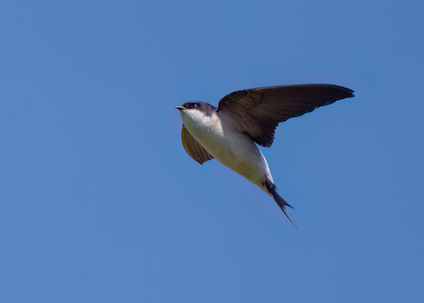
The Sussex Ornithological Society is organising a breeding House Martin survey for 2026, following the national survey carried out in 2015.
House Martins breeding colonies are most strongly associated with buildings, with the species having the most success in rural towns and villages. The largest recorded colonies reported in Sussex during 2024 were 50 occupied nests at Racton and 36 active nests at Plumpton College (2024 Sussex Bird Report, SOS, 2025).
The national survey carried out in 2015, and casual records that year identified 125 1km squares containing a House Martin colony in Sussex. A further 57 1km squares were identified as supporting a colony from subsequent casual records to 2025, and Nest Record Scheme Data. The county population in The Birds of Sussex (Thomas, 2014), was estimated based on the BTO Atlas 2007-11, to be of 5,100 pairs.
The selection of 1km survey squares for the 2026 survey, is based on those with previous breeding between 2015 and 2025. This should hopefully mean there is more chance of encountering nesting House Martin on the visits, which is generally more enjoyable for surveyors, and it is aimed to be representative of the current range of House Martins across the county. The survey will aim to compare the productivity of House Martin colonies in 2026 with previous years, and to identify if particular habitat features are of importance to their breeding success.
To get started, view the Western section or Eastern section of the county map, to see which 1km x 1km survey squares are available.
Preparing for your survey
Once you have decided which available survey square(s) to take on, you can confirm your interest on the website. You will receive an email confirming that you have been assigned these squares. It is worthwhile printing an OS map of the relevant 1km survey square(s), and a recording form from the links on the website.
Before your first survey visit, it is a good idea to plan your route by identifying areas of potential habitat using your local knowledge of the survey square and the suitable nesting habitats (in this case predominantly buildings), or via Google earth or OS maps.
Ideally, you should aim to be able to view of all the suitable buildings and any other suitable nesting habitat in the square.
It is assumed that most of the survey will be completed from public rights of way or access land. If part of the colony is not visible, surveyors can request permission from landowners to enter land relevant to the survey. This survey does not grant access to private land, but if access is agreed between surveyors and landowners that would be fine.
Survey Instructions (Overview)
Surveyors should be confident in identifying House Martin and their nesting colonies by sight and sound.
Surveyors are encouraged to complete an initial visit to each of their allocated 1-km squares to familiarise themselves with the site and the buildings present. This initial visit would be completed between mid to late May to identify potentially suitable nesting habitat, to make an initial search for pre-existing House Martin nests, and to speak where necessary to landowners and homeowners about the survey.
Two further visits will be made to each square, one during the period 1st June to 24th June and another during the period 25 June to 19 July, with at least two weeks between the two visits.
Each visit should cover all suitable nesting habitat and can be made at any time of day. If no House Martin nests are located during the initial search in May or during the first survey visit in June, then a second survey visit is not required.
Further detailed instructions, including the survey form are available for download once you have selected at least one survey square to take on.
Survey website developed by Garganey Consulting